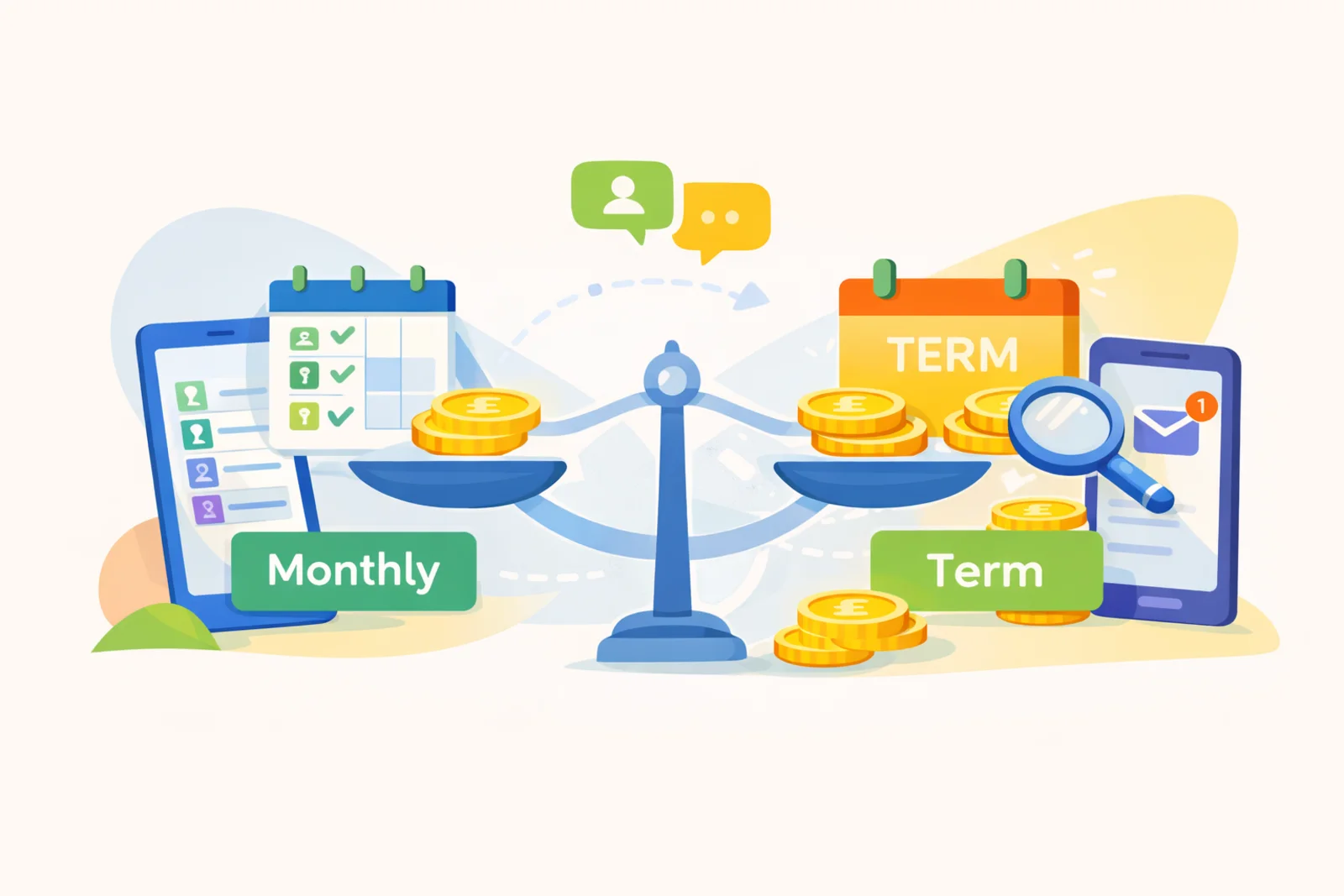
Choosing monthly or term payments is not only a finance decision. It changes enrolment behaviour, admin workload, and how quickly small issues become overdue balances.
Many providers pick a model based on what they have always done. That can work for a while, but it often creates avoidable pressure when demand shifts or household budgets tighten.
This guide helps you choose with practical trade-offs, not fixed rules.
The core trade-off in plain terms
- Term payments usually improve upfront cashflow and reduce monthly admin cycles.
- Monthly payments can lower entry friction for families and smooth affordability.
Neither model is automatically better. The right choice depends on your class type, household mix, and team capacity for follow-up.
Start with your operating constraints
Before you decide, answer four questions honestly:
- How much cashflow certainty do you need before term starts?
- How much time can your team spend on recurring follow-up each month?
- How price-sensitive are new enrolments in your area?
- How often do people join or leave mid-term?
If you cannot answer these with rough numbers, gather one term of baseline data first.
When term payments usually work best
Term payments are often stronger when:
- Your classes are term-structured and progression-based.
- Capacity is tight and places are in high demand.
- You need predictable revenue to commit venue or staff costs.
Term payments also reduce the number of collection events each household generates. Fewer collection events usually means fewer payment failure touchpoints.
For providers with clear term cycles, term-based enrolment software and class payment software should be reviewed together.
When monthly payments usually work best
Monthly payments are often stronger when:
- You run ongoing classes with flexible start points.
- Households prefer lower upfront commitment.
- You have regular mid-term joiners.
Monthly models can improve conversion where full-term upfront payment feels too high, but they increase recurring payment administration. You need clear status tracking and follow-up routines.
If collections and reminders are not well connected, monthly models can increase admin load quickly.
Cashflow and risk: simple comparison method
Use a practical three-step comparison with your own numbers.
Step 1: model expected intake
Example assumptions:
- 180 active participants.
- Average class fee £36 per month equivalent.
- 12-week term.
Term model might collect around £108 per participant at term start. Monthly model collects around £36 each month.
Step 2: model failure points
Estimate failed or delayed collections by model.
- If monthly failure rate is 5% per collection cycle, you have more follow-up events over the term.
- If term upfront payment fails less frequently but in larger amounts, your escalation workflow needs to be clear.
Step 3: model admin effort
Track realistic admin minutes, not ideal assumptions.
- Monthly models may need weekly review of small overdue items.
- Term models may need concentrated follow-up during enrolment window.
The decision should include both cash impact and staff time.
UK practical example 1: dance and theatre school
A London provider with 240 students moved from monthly to term payments for core classes, while keeping monthly options for selected intro programmes.
Before change:
- Monthly collections generated frequent small failures.
- Admin spent about 7 hours a week on follow-up.
After change:
- Core programme cashflow became more predictable before term start.
- Weekly follow-up fell to about 3.5 hours.
- Intro programme conversion stayed stable due to monthly option.
The useful lesson is mixed policy by programme, not one global rule.
UK practical example 2: community activity provider
A provider in Coventry runs 14 weekly classes for children and teens. They tested term-only pricing and saw improved upfront revenue but a drop in new enquiries converting.
They shifted to:
- term payments for high-demand progression classes,
- monthly payments for general beginner classes.
Within one term:
- beginner class conversion improved by 11%,
- arrears by value stayed stable because follow-up was linked to clear due dates and communication templates.
The model worked because payment policy matched class context.
Parent and guardian behaviour considerations
Payment choices affect enrolment behaviour.
Term payment may attract families ready to commit and can reduce short-notice churn. Monthly payment may widen access for households managing monthly budgets.
Neither is "right" in principle. Match your policy to the behaviour you want and can support operationally.
If your communications are broad and untargeted, both models become harder to manage. Keep messages linked to specific classes and due dates with parent communication tools.
Handling arrears without escalating friction
Whatever model you choose, arrears handling needs boundaries and timing.
A practical routine:
- daily scan of newly overdue items,
- weekly review of balances older than 14 days,
- clear escalation path for persistent non-payment.
This is where arrears and overdue payments workflow matters. Small delays are easier to resolve early.
Monthly vs term: decision guide by provider type
You can use this quick guide as a starting point.
Choose term-first when:
- your timetable is strongly term-based,
- classes usually run close to capacity,
- and you need clearer upfront revenue predictability.
Choose monthly-first when:
- ongoing joiners are common,
- conversion friction is currently high,
- and your team has reliable recurring follow-up routines.
Choose mixed model when:
- you run both high-commitment and flexible classes,
- or different age groups have different payment expectations.
Many UK providers end up with a mixed model because it reflects real demand patterns better than a single policy.
Build the policy into enrolment flow
Payment policy should be visible at enrolment stage, not added later by email.
Make sure families can clearly see:
- total expected amount,
- due timing,
- what happens on late or failed payment,
- and who to contact about payment questions.
If this is unclear, support traffic rises and trust drops.
Common mistakes when choosing payment model
- Picking monthly or term based only on competitor pricing.
- Ignoring admin time needed for recurring follow-up.
- Applying one payment policy to every class type without testing.
- Delaying arrears process design until balances already build up.
- Sending payment messages that are not linked to specific due items.
If you're using Classia...
- Set payment approach by class type, then align enrolment setup with term-based enrolment software.
- Track payment state centrally with class payment software.
- Run a weekly overdue review using arrears and overdue payments.
- Keep payment reminders tied to class context via parent communication tools.
Final recommendation
The better payment model is the one your team can run consistently for a full term while protecting both cashflow and family experience.
For many providers, that means using both models deliberately rather than forcing one. Start with your highest-pressure classes, test outcomes for one term, and adjust based on real data.
Classia is most useful in this decision when you want payment status, enrolment context, and follow-up actions connected in one operational view.